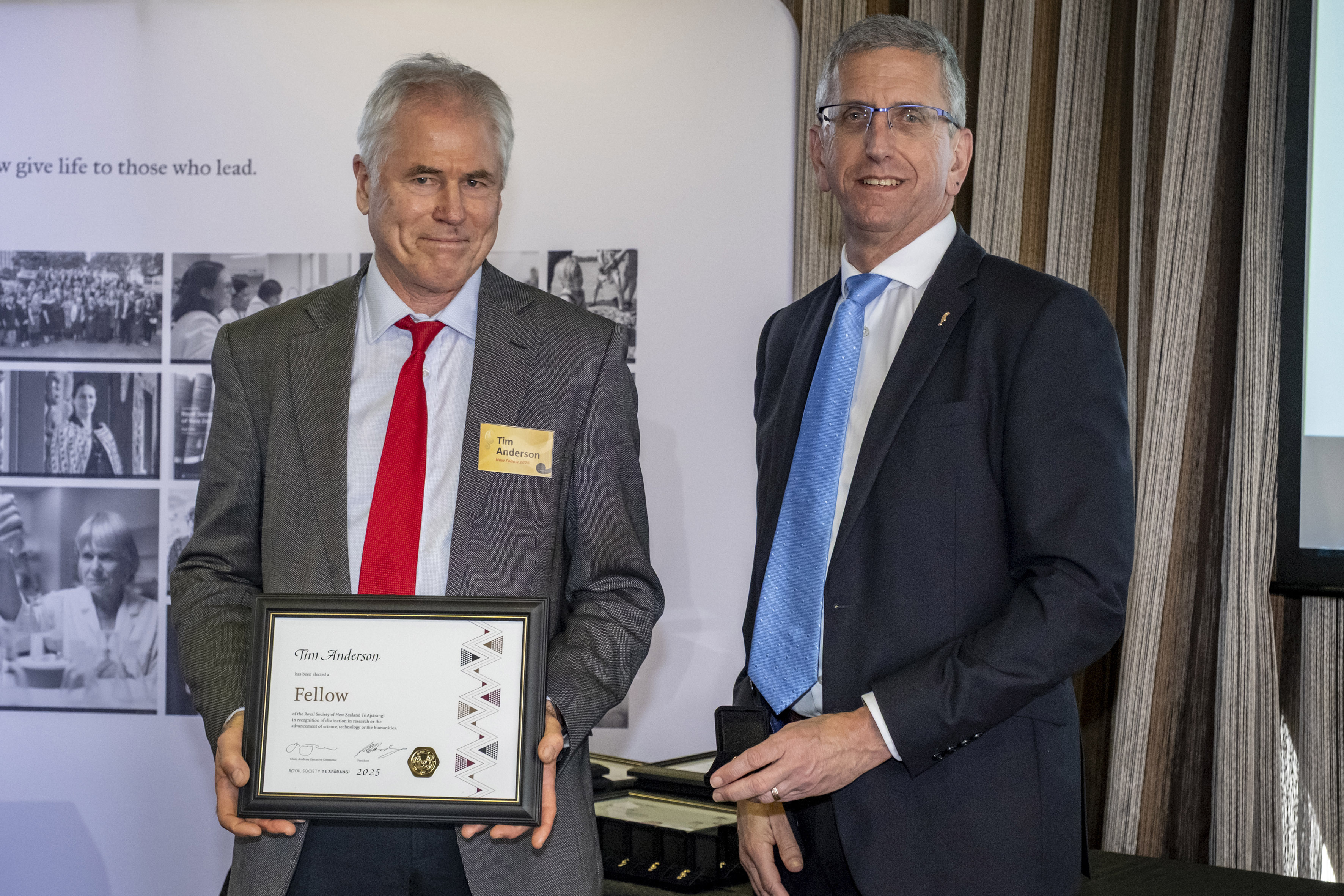
Professor Tim Anderson – Fellow of the Royal Society of New Zealand
27 Oct 2026
Old Boy Professor Tim Anderson BSc(Hons), MBChB, MD, FRACP (8176) has been selected as a Fellow of the Royal Society of New Zealand (FRSNZ).
A leading neurologist–scientist at the Department of Medicine in Christchurch, Tim has been acknowledged for his clinical research in neurology and movement disorders. His international reputation reflects his outstanding achievements in movement disorders, particularly Parkinson’s disease.
Tim’s clinical research includes neurodegenerative disorders, such as Alzheimer’s and Huntington’s diseases, disabling neuropsychiatric complications, and traumatic brain injury while his discoveries range from analysis of speech and swallowing impairments to tracking eye movements for diagnosis and management.
As the New Zealand Brain Research Institute (NZBRI) Clinical Director for 15 years, Tim has co-led a groundbreaking international longitudinal cohort study of Parkinson’s patients that is helping to establish biomarkers of cognitive decline.
A member of Condell’s House from 1969–1973, Tim is “rather stunned, but thrilled” to be elected as a Fellow. He believes the prestigious honour is “the result of the wonderful and fruitful collaboration between the many neuroscientist and clinician colleagues over some 20 years” at the Institute.
The Royal Society of New Zealand “promotes critical engagement with knowledge” to raise awareness and advance lifelong learning.
We have asked Tim to answer a few questions, reflecting on his remarkable career.
Were you always interested in medicine at Christ’s College and did any teacher inspire you in the Sciences?
No, even though my father and grandfather and, subsequently, my brother, Nigel, (7785) were radiologists, my initial interest was in being a science journalist. However, I didn’t get into journalism school and after my first year in Sciences at the University of Canterbury, I translocated to Dunedin where I did a double major in Psychology and Physiology at the University of Otago, followed by a postgraduate research year in Physiology, which involved setting up a diagnostic test for multiple sclerosis for the Dunedin Hospital Neurology Department. That got me interested in medicine and I gained entry into the Medical School where I continued to maintain an interest in neurology and neuroscience based on my postgraduate year. After qualifying and working in various wards and disciplines around Christchurch Hospital, I realised that I was still most interested in neurology and started specialty training. I was lucky enough, through my Christchurch mentor, Professor Ivan Donaldson, to obtain a research and training position in London with the world-leading expert in the neurology subspecialty of movement disorders (neurological disorders involving abnormal movements, such as tremors, spasms, and jerks). I completed my Doctorate of Medicine (MD) research in London on eye movements in neurological disorders, especially Parkinson’s disease, and returned to Christchurch in 1992, joining the Neurology Department and Otago Medical School as a consultant neurologist. I continued my research, especially in eye movements and, with a psychologist colleague at UC, Professor John Dalrymple-Alford, set up an ever-expanding multi-disciplinary research group at the NZBRI.
What do you see as the greatest outcomes of your work?
My most rewarding achievement has been to help support and nurture new neuroscientists and clinicians into developing their own research and clinical careers, despite the major challenges of insufficient funds in New Zealand for neurological research at a time when age-related neurodegenerative diseases, such as Alzheimer’s and Parkinson’s, are exploding and threatening to overwhelm health resources. I am most proud of our longitudinal Parkinson’s research study (NZP3), now running for nigh on 20 years, with a multitude of repeated sophisticated patient assessments – including MRI, PET, EEG, blood biomarkers – allowing us to contribute critical data to many important international consortia and studies.
Tim highlights that “what I have discovered over my working life is that perseverance, stickability, and an ability to get on with people are just as, or perhaps more, important than pure academic ability”.