
Michael Horton – leaving an imprint in business and philanthropy
19 Jun 2026
A man of words, the arts, and philanthropy, Old Boy Michael Horton has always stood strong in his belief that giving brings the greatest reward.
Among the first boys in Richards House, he discovered his love of languages – including te reo Māori – and the written word, alongside the magic of the cello, while a College boarder in the 1950s. Named Head Prefect in 1956, Michael quickly understood the power of one small gesture in sustaining and advancing the success of another.
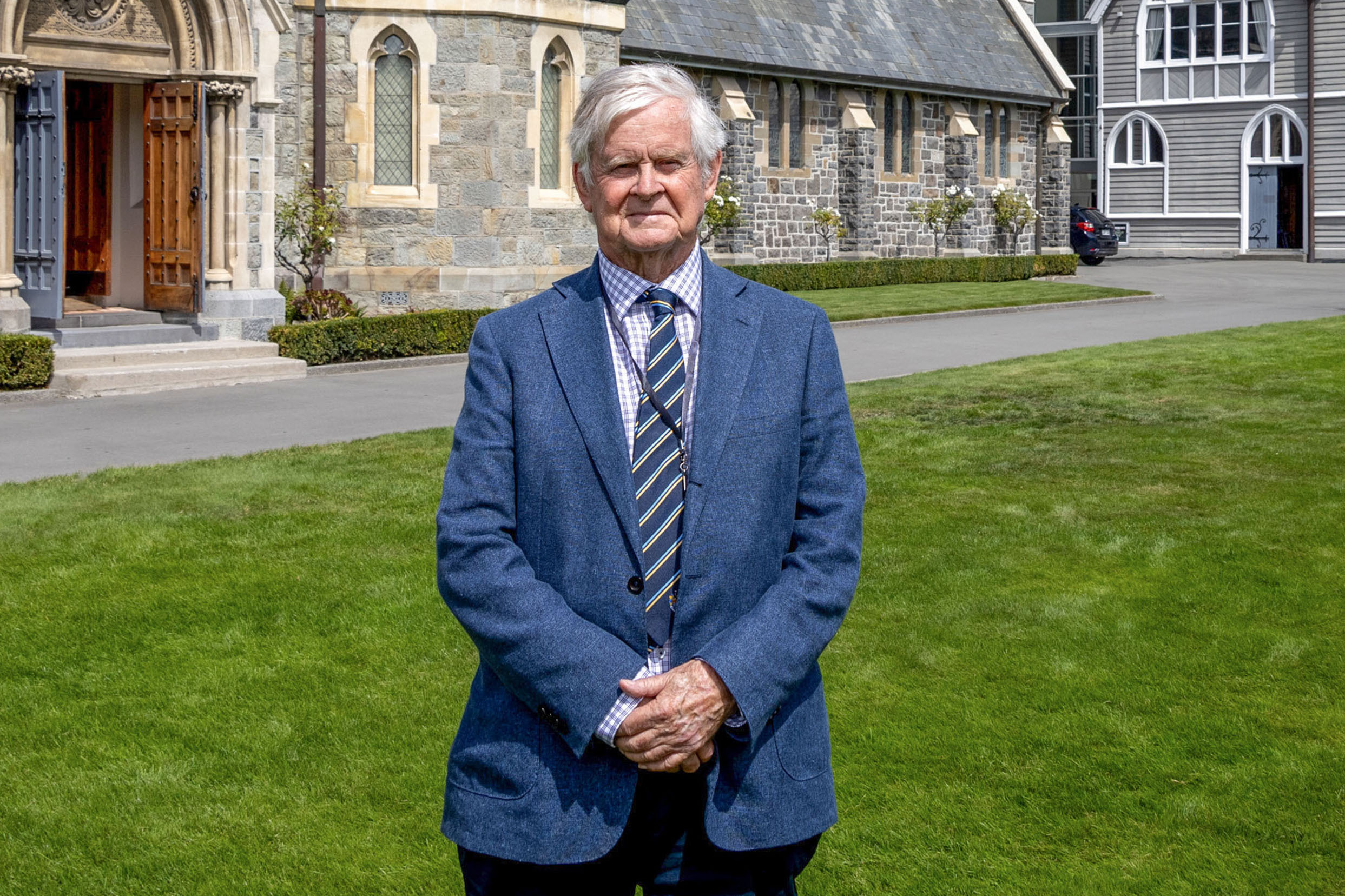
Now 87, Michael was made a Companion of the New Zealand Order of Merit (CNZM) in 2010 in recognition of his services to philanthropy. Today, the University of Cambridge law graduate, former New Zealand Herald publisher, and free speech campaigner continues to share his business expertise and gift for giving in both New Zealand and Australia.
Despite living in Auckland, Michael followed the “family tradition” and was sent south to Christ’s College in 1952. Today, he believes that “everything I have picked up and learnt at College has been of value to me in life”.
“I was sent to College because my grandfather (1882–1888) went there, and my father (1922–1926), and Canterbury was regarded as the centre of education,” he explains. “In those days, you spent a day on the train travelling from Auckland to Wellington, and then boarded the overnight ferry. When we reached Lyttelton, we got back on a train to travel to Christchurch. I remember thinking it was cold and that I did not know anyone at school, but you just got on with people.
“After four years in School House, I shifted to the new Richards House in my final year. I occasionally played for the 1st XV, captained the 2nd XV, was hopeless at cricket, and did a bit of rowing.”
However, his passion for languages was nurtured at College.
“I’m a language nut,” Michael points out. “We learnt Latin – such an important language and I still recall it. I also had to do Latin at Cambridge for my law degree. One of my business interests involved printing in foreign languages. I set up that business when I left the New Zealand Herald. We produced material in Russian, Chinese, Samoan, and Fijian. I got quite good at reading Russian, along with Chinese and French – having lived in France. I could read a bit of German, Japanese, and Māori.
“When I was at College, fellow student Bill Wardell, who became a distinguished medical scientist in the United States, suggested that we should learn more about the Māori and te reo. So, we approached Headmaster Reg Hornsby. He simply replied, ‘I’ll arrange it for you’, and organised a tutor.”
Michael was soon dedicated to his new interest and loved being able to share the language with a remarkable classmate.
“Bill became an eminent medical scientist in pharmaceutical research and drug development. He was responsible for huge changes in the approval of new medicines, particularly in North America, and, obviously, saved thousands of people.
“I think we were ahead of our time in wanting to learn Māori at school,” Michael explains. “For me, it became very helpful because the Herald ran – back in my workdays – quite a lot of death notices in Māori, including some of the text. So, I could correct some of the imperfect text of the Māori death notices that came from funeral homes. If you take an interest in a language, you tend to carry on with it.
“I used to say to people that if you get The Bible in Māori, that’s probably the best way to learn the language. Especially in the New Testament, you know what the text is in English. And then you see it in Māori, and the diverse words and nouns and adjectives. You can really learn Māori well by studying the King James Version written in Māori.
“I recall a former classmate saying – many decades later – that no one spoke Māori at College during the 1950s. Well, that was not the case if you actually thought for yourself and asked if you could learn.”
Of his time at College, Michael recalls being “useless at Drama, but enjoying playing the cello in the orchestra and being a member of the Chapel Choir”.
Of his teachers, “James Walshe, the English teacher, was very good and ahead of his time” (later becoming a medical doctor) while “Hornsby was good with Latin”.
“I also enjoyed Edward de Laberbis – ‘Bis’ – with his French, Ray Aitcheson, who was good with Art; senior Mathematics master FE Morris, and, of course, a famous teacher, Rick Bromley. My time at Christ’s College certainly built up my resilience, setting me up for my next stage in life.
“Straight out of school we had compulsory military training, and I then joined the family firm, Wilson and Horton, as a cadet reporter. You had to have shorthand and typing, be proficient and capable of so many words a minute. Journalism is a terrific profession for young people as you have to go and seek out people and ask them questions and find the stories. It enables you to go anywhere and be confident and establish relationships.”
The Horton family has a long history in publishing in New Zealand, dating back to the 1870s. Today, Michael still values the opportunity to work for a revered NZ Herald editor, Orton Sutherland Hintz, known as ‘Budge’.
“However, my first appearance in the press came while I was still at College and wrote an article about the 1956 Olympic Games in Melbourne for The Star newspaper,” he says. “I did a one-year cadetship with the Herald before I went to England to do my law degree at Trinity Hall, Cambridge. However, having completed my degree in law, I thought ‘actually, I quite like writing’, so my father came over to England and got me a job with a group of newspapers that no longer exists probably.”
He worked on both the Wiltshire Times and the Middlesex Guardian News.
After literally learning from the ground up, Michael returned to New Zealand – and the NZ Herald – in 1961.
“The last thing the Herald wanted was Michael Horton, so I was put in the worst department possible – moving newsprint reels around before you print,” he recalls. “I learnt every facet of the business, also spending time in sales and circulation. It gives the workers confidence if the boss knows what he is doing. With my law degree, I also did a bit of court reporting.”
With his Cambridge experience, he was also asked to teach people how to speak in public at the Auckland Debating Society. Among those in his ‘class’ were future Prime Minister David Lange and Commonwealth Secretary-General Sir Don McKinnon.
Michael would go on to share his voice in support of a range of causes and fully oversee the family business, holding the title of managing director of Wilson and Horton from 1972 to 1995. The business enjoyed rapid growth through to the early 1990s, with a huge number of columns of classifieds.
Michael describes the “gold” of classifieds as a “Trade Me-type operation in print”.
“It was extremely profitable and a great business. We also spread our risk by going into commercial printing.”
Aside from his print commitments, Michael suggested to his cousin, Australia-based media heavyweight Sam Chisholm, that his boss, billionaire Kerry Packer, might be interested in setting up a private TV channel in New Zealand. While that proposal did not gain traction, Michael pressed on with his broadcasting plans, erecting studios in Mount Wellington, Auckland.
“However, when we applied for the broadcasting licence, it was turned down by the then Labour government,” he says. “We were trying to set up an early version of Sky TV. Interestingly, Sky TV is now broadcasting from Mount Wellington and our studio was the basis.”
Generally, Michael believes it is easier to operate in Australia, England, and the United States when it comes to business investment, with New Zealand “too reliant on milk and tourism” for international returns.
Amid a changing media environment and with a flourishing printing business on the horizon, Michael sold the family’s stake in Wilson and Horton to Irishman Tony O’Reilly’s Independent News & Media Group in 1996. He then established Horton Media – Australasia’s largest independent contract media printing business – before stepping down as chairman in 2014, recognising great change was coming for print.
Energised by the remarkable drive of his late wife, Dame Rosie Horton, DNZM QSO QSM, the family name has become synonymous with trans-Tasman philanthropy. The Hortons have donated – and raised – millions of dollars.
For more than 40 years, Dame Rosie was devoted to mentoring and fundraising, steering support for the Arts, Starship, the New Zealand Breast Cancer Foundation, and the Centre for Brain Research at the University of Auckland, to name just a few of the many groups to have benefitted from the support of the Hortons. Much of their focus has centred on areas affecting women, children, and health.
One of their greatest art achievements was to gather arguably the best collection of Aboriginal art in Australia and donate 193 works to the Art Gallery of NSW.
“We worked as a pair all around Australia,” Michael recalls. “We travelled all over northern Australia in particular, building up a large collection. It is very precious. Rosie put so much energy into supporting Aboriginal artists.”
Returning to College for the 175th anniversary celebrations in 2025 and sharing his advice to Year 9 students today, Michael suggests that they “fill their glass and take advantage of every opportunity in order to trigger something inside”.
“You’ve got to read, you’ve got to study, you’ve got to work – sometimes things work, sometimes they don’t.
As to the future of College, “change is inevitable”.
“A co-ed education may become an economic reality that College has to face one day. For now, I suggest that the school buys more property to prepare for inevitable change.”